Alpha-Beta Pruning
Alpha-Beta pruning is a search algorithm used to reduce the number of nodes in a minimax search tree. When the algorithm evaluates that the subsequent moves of a strategy are worse than those of the previous strategy, it stops the subsequent development of the strategy. This algorithm achieves the same conclusion as the minimax algorithm, but prunes branches that don’t affect the final decision.
Alpha and Beta
is the value of the best (highest-value) choice we have found so far at any choice point along the path for MAX. And it’s initialized as .
the value of the best (lowest-value) choice we have found so far at any choice point along the path for MIN. And it’s initialized as .
Example of Pruning
The picture below is a case of a searching tree that has not been cut. In Alpha-Beta pruning, the first layer searches for the largest , the second layer searches for the smallest , and so on for the following layers. The pruning is performed when the value of a node is larger (or equal) than of its parent node or smaller (or equal) than of its parent node.
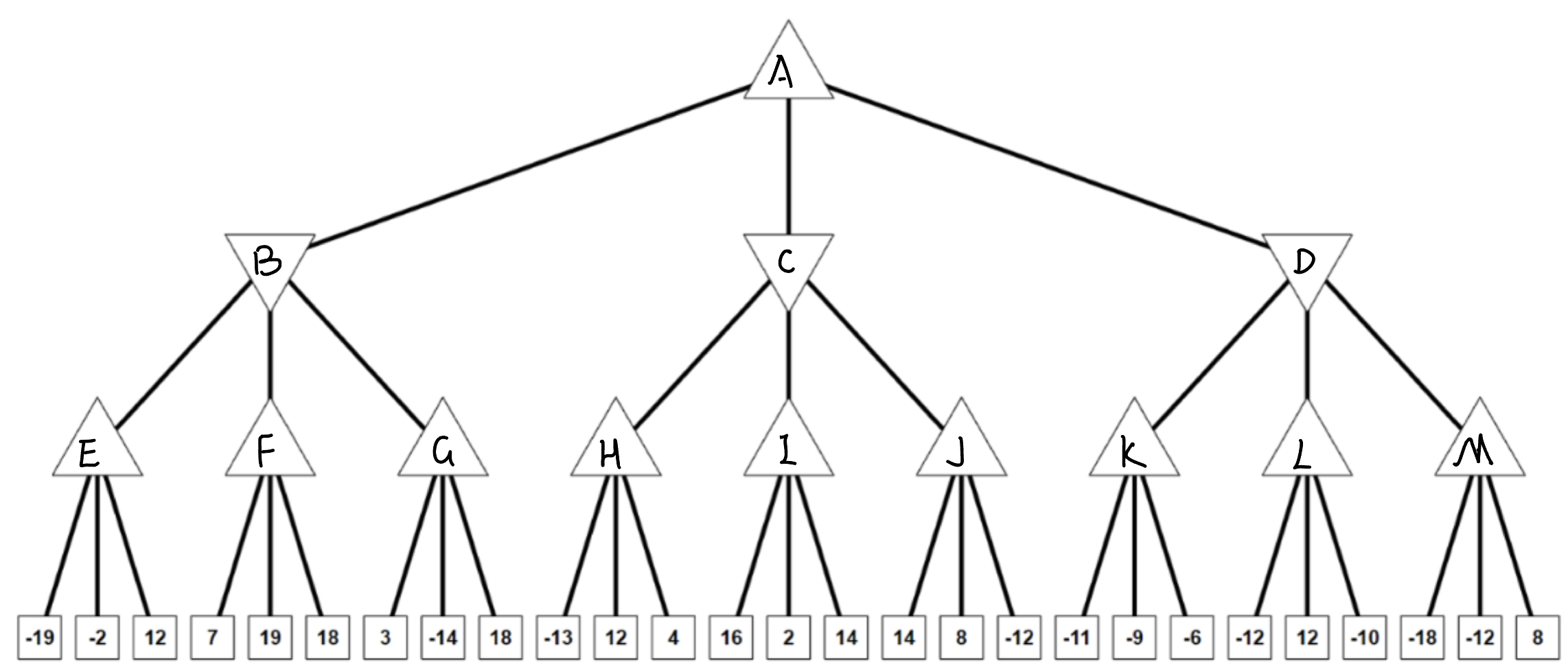
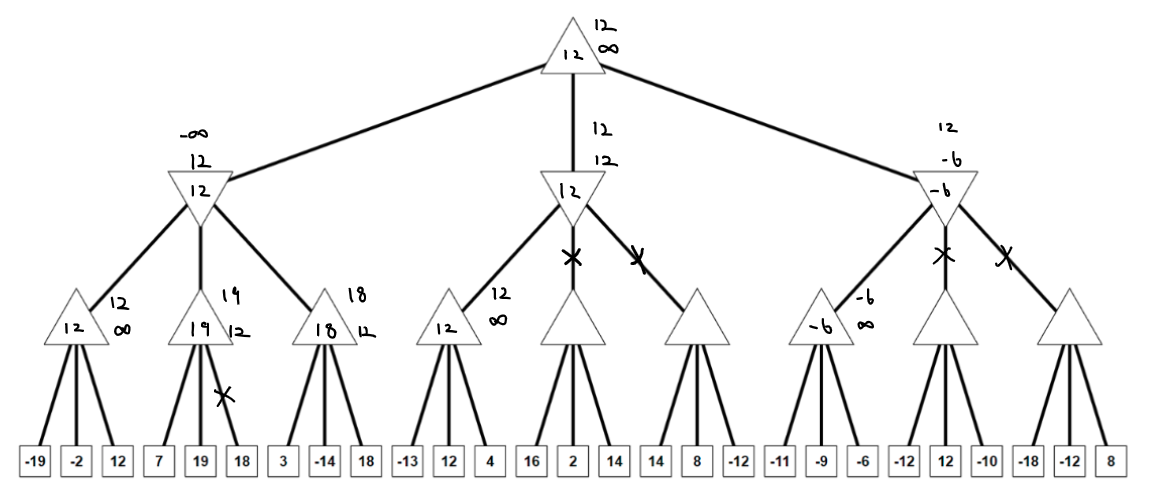
(1) Depth-first search starts at A and goes all the way to the last layer (nodes: -19, -2, 12). So the largest one 12 is set as the value for node E, and in E is also updated as 12.
(2) If the value in a child node is determined, the upper and lower bounds can be returned to the parent node. So of B can be updated as 12.
(3) Keep searching from E to F, the second child node of F is 19, which is larger than of B. So the searching on this node can stop. So the value of F is set to be 19 and the branch with node 18 is pruned. It’s the same for G, its third node is 18, which is larger than of B, then G is set to be 18.
(4) When the child node values of B are all determined, B choose the smallest one (12) to be its value, and its , can be returned to its parent node. So of A is updated to be 12.
(5) of the rest child nodes are updated to be 12 because of A is determined.
(6) Depth-first search starts again from A to child nodes of H. The value of H is set to be its largest child node 12, and its is also updated to be 12.
(7) The upper bound and lower bound of H is returned to its parent node C. So of C is updated to be the value of H 12. In this case, of C is equal with of A, so the searching on node C can stop and branches of I and J can be pruned.
(8) Then the searching goes from A to the child nodes of K. The value of K is updated to be the largest child node -6. Because -6 is smaller than 12 (update on step 5), of K would keep 12.
(9) The value of K -6 is returned to node D and it updated to be of D. Because of A is larger than of D, the searching on node D can stop and branches of L and M can be pruned.
Alpha-Beta Pruning in Python
1 | |
1 | |
All articles in this blog adopt the CC BY-SA 4.0 agreement except for special statements. Please indicate the source for reprinting!